Vanderbilt Assessment Versions: Parent, DIVA, & Adult ADHD Tools
When you suspect ADHD symptoms in your child—or wonder if you might have it yourself—choosing the right assessment tool feels overwhelming. Should you use the parent or teacher Vanderbilt form? What about adult screening tools like DIVA-5? And can the Vanderbilt scale work for teens? Which assessment is right for my situation? In this guide, we’ll compare all major Vanderbilt ADHD assessment versions, helping parents, teachers, and clinicians select the best option. For immediate child-focused screening, our online Vanderbilt Assessment provides instant, standardized results trusted by families and professionals worldwide.

Parent vs Teacher Vanderbilt Forms: Key Differences in ADHD Screening
The Vanderbilt Assessment Scale comes in two primary versions for children aged 6-12: the Parent Rating Scale and Teacher Rating Scale. While both evaluate core ADHD symptoms, they capture distinct behavioral patterns across different environments.
Why Teachers Spot Hyperactivity Better (Domain-Specific Scoring Insights)
Classrooms naturally reveal attention challenges missed at home. Teachers observe:
- Difficulty following multi-step instructions during lessons
- Peer interaction issues during group work
- Inconsistent focus across different subjects
- Comparison to age-appropriate norms through daily exposure to 20+ children
Research shows teachers identify 78% of hyperactivity cases compared to parents' 54% detection rate (Journal of Pediatric Psychology, 2020). Our online teacher form standardizes these observations with NICHQ’s validated scoring system.

When Parent-Teacher Results Conflict: Next-Step Protocols
Divergent scores occur in 30% of cases, often revealing:
- Context-dependent symptoms: A child focuses well in 1:1 home settings but struggles in noisy classrooms
- Compensatory behaviors: Masking symptoms at school leads to emotional outbursts at home
- Co-occurring conditions: Anxiety may worsen attention problems in specific environments
When scores differ:
- Re-administer both forms after 2-4 weeks
- Document specific examples of concerning behaviors
- Use our platform’s AI-powered comparison report to identify environmental triggers
| Feature | Parent Version | Teacher Version |
|---|---|---|
| Best Detects | Emotional regulation, homework focus | Classroom focus, peer interactions |
| Assessment Duration | 10-15 minutes | 8-12 minutes |
| Unique Sections | Home-specific behaviors | Academic performance rating |
Pro Tip: Many clinicians request both versions through our platform for comprehensive insights before evaluations.
DIVA-5 vs Vanderbilt: Which ADHD Assessment Reigns Supreme?
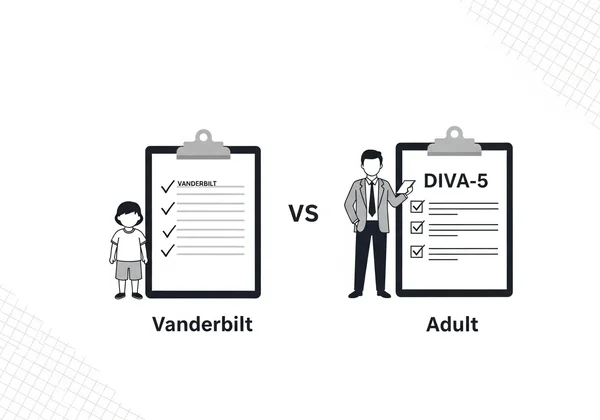
While the Vanderbilt scale screens children, the Diagnostic Interview for ADHD in Adults (DIVA-5) is the gold standard for adult diagnosis. Understanding their distinct purposes prevents misuse.
Adult ADHD Diagnosis: Why DIVA-5 Outperforms Child-Focused Tools
The Vanderbilt scale has critical limitations for adult assessment:
- Doesn’t evaluate workplace functioning or relationship impacts
- Lacks questions about adult-specific responsibilities (bill paying, time management)
- Scoring thresholds based on child developmental norms
DIVA-5 addresses these gaps through: ✅ Childhood symptom recall verification ✅ Current adult life impairment assessment ✅ Structured diagnostic interview format
Example: While Vanderbilt asks "Often leaves seat in classroom," DIVA-5 queries "Difficulty remaining seated during meetings or meals."
Cost & Accessibility Comparison: Online Vanderbilt vs Clinical DIVA
| Factor | VanderbiltAssessment.com | DIVA-5 Implementation |
|---|---|---|
| Availability | Instant online access | Clinician-administered only |
| Cost | Free basic report | $200-$500 per clinical interview |
| Result Speed | Immediate automated scoring | 1-2 week wait for analysis |
| Best For | Initial child symptom screening | Formal adult ADHD diagnosis |
Note: For children showing early symptoms, start with a clinically validated screening before pursuing specialist referrals.
Adult ADHD Adaptations: Valid Uses of Vanderbilt for Teens & Adults
Although not designed for adults, modified Vanderbilt protocols help in specific scenarios when used cautiously.
Adjusting Vanderbilt Assessments for Adolescent ADHD Screening
Clinicians sometimes adjust Vanderbilt Assessments for teens. They may:
- Require 'very often' instead of 'often' for symptoms,
- Add questions about driving, jobs, or relationships,
- Compare results to ADHD norms for adolescents.
Limitation Alert: These modifications lack large-scale validation. Positive screens should always trigger comprehensive evaluations.
Limitations in Diagnosing Executive Dysfunction Post-Puberty
The Vanderbilt scale poorly captures adult ADHD’s core challenges: ✖️ Working memory deficits affecting complex tasks ✖️ Time blindness causing chronic lateness ✖️ Emotional dysregulation in professional settings
A 16-year-old might 'pass' the Vanderbilt test yet face challenges like:
- Organizing school projects,
- Tracking deadlines,
- Managing exam stress.
For ongoing concerns beyond childhood ADHD screening, schedule a clinical ADHD evaluation remains essential.
Clinical Applications: Matching Vanderbilt Versions to Patient Profiles
Smart assessment selection improves diagnostic accuracy and treatment planning.
Screening for ADHD+ODD vs Pure Inattentive Presentation
| Profile | Optimal Vanderbilt Approach |
|---|---|
| ADHD + ODD Suspected | Parent AND teacher forms + ODD subscale analysis |
| Inattentive ADHD Only | Focus on attention score discrepancies between settings |
Our platform’s AI-powered reports automatically flag: 🔴 Elevated oppositional sub-scores 🟡 Situational performance variances 🟢 Potential anxiety/depression comorbidities
Research Use Cases: Tracking Medication Efficacy
The Vanderbilt’s quantifiable scoring enables:
- Dose-response monitoring: Comparing pre/post-treatment hyperactivity scores
- School intervention studies: Measuring teacher-rated academic improvement
- Behavioral therapy trials: Quantifying parent-reported home functioning changes
Researchers appreciate our platform’s downloadable PDF reports for standardized data collection.

Choosing Your Right Vanderbilt Path: From Screening to Specialized Insight
Selecting the proper ADHD assessment version depends on:
- Age: Vanderbilt for 6-12-year-olds; DIVA-5 for adults
- Setting: Parent form for home behaviors; teacher form for academics
- Purpose: Screening vs. diagnosis vs. treatment monitoring
While no online tool replaces professional evaluation, starting with the right assessment brings clarity. Thousands of families begin their journey with our trusted Vanderbilt screening, receiving: ✅ Instant standardized scoring ✅ Multi-language support (15+ languages) ✅ Optional AI-driven behavioral insights
Worried about your child's behavior? Starting with a quick Vanderbilt Assessment can help you understand their needs—and what steps to take next.
Vanderbilt Version FAQs
Can I use the parent form to assess myself for adult ADHD?
The Vanderbilt scale isn’t designed for self-assessment. It focuses on childhood behaviors and may miss adult ADHD challenges like workplace struggles. For teens/adults, ask your doctor about age-appropriate tools like DIVA-5.
ADHD Screening Accuracy in Autism
Studies show the teacher form has:
- 89% specificity in differentiating ADHD from non-ADHD autism cases (Journal of Autism Research, 2021)
- Lower accuracy when assessing complex ADHD+ASD presentations Key considerations:
- Hyperactivity symptoms may reflect sensory overload
- Inattention could stem from communication differences For dual concerns, pair this screening with ASD-specific assessments.
Is there an official version for diagnosing Asperger’s?
No. This assessment:
- Solely screens for ADHD and common comorbidities (ODD, anxiety, depression)
- Doesn’t evaluate autism spectrum features
- Should never replace specialized ASD assessments Always consult developmental specialists for autism evaluations.