Parent Teacher Vanderbilt Rating Differences and Next Steps
Why parent and teacher Vanderbilt scores often differ
Many families feel stuck when parent and teacher Vanderbilt forms do not match. One form may show high concern, while the other looks closer to typical behavior. That mismatch can feel confusing, but it is common in real screening situations.
Different settings create different demands. Home routines, classroom structure, peer expectations, sleep quality, and transition pressure can all shape how symptoms appear. A child may look regulated in one setting and struggle in another without anyone giving inaccurate ratings.
The first goal is not to decide who is right. The first goal is to understand context and collect better information. The online Vanderbilt assessment tool is most useful when parent and teacher observations are reviewed side by side with clear examples.
This article explains how to interpret score differences safely, how to prepare better follow-up conversations, and when to escalate concerns for immediate professional support.
Disclaimer: The information and assessments provided are for educational purposes only and should not replace professional medical advice, diagnosis, or treatment.

Interpret score gaps without jumping to conclusions
Review DSM-based symptom context and impairment across settings
Vanderbilt forms support screening, not diagnosis. A score pattern can highlight concern areas, but it does not confirm a medical diagnosis by itself. That boundary is essential for safe decision-making.
CDC guidance summarizes DSM-5 thresholds by age (CDC ADHD diagnosis guidance).
- Children up to age 16 generally need six or more symptoms.
- People age 17 and older generally need five or more symptoms.
This helps families understand why one rating form alone is not enough.
CDC also notes that several symptoms should be present before age 12 in diagnostic frameworks. This timeline reminder prevents overreliance on one recent difficult week when discussing longer-term patterns.
Use score differences as a prompt for deeper observation, not as a final label. Ask what changed in routines, expectations, and supports between home and school during the same period.
Common reasons parent and teacher observations diverge
Different adults see different moments of the day. Teachers may observe sustained attention during structured academic tasks. Parents may observe transitions, homework resistance, sibling conflict, and evening fatigue.
Classroom systems also affect behavior expression. Some children regulate better with predictable schedules and visual cues at school, then show more dysregulation in less structured home windows. Others mask difficulty at school and release stress after returning home.
CDC guidance emphasizes that impairment should be evaluated across social, school, or work functioning and across two or more settings. That is why disagreement between settings is clinically important information, not a process failure.
To improve clarity, document specific examples linked to time and setting. "Could not finish math worksheet after two prompts" is more useful than "had trouble focusing." Specific observations improve later professional interpretation.
Build a shared next-step plan with clinicians and schools
Questions parents and teachers can prepare before follow-up visits
A follow-up conversation works best when both settings bring concrete patterns, not only score totals. Prepare questions in advance so everyone discusses evidence the same way.
Helpful questions include:
- Which symptoms appear in both home and school settings?
- Which symptoms appear only in one setting, and under what conditions?
- What supports have already been tried, and what changed afterward?
- Which concerns affect learning, relationships, or daily routines most?
- What additional evaluation steps are recommended now?
This structure keeps the conversation collaborative. It also reduces blame language that can appear when score differences feel personal.
Before the visit, review your summary inside the parent and teacher form workflow. Bring short behavior notes for the same dates covered by the completed forms. Date-aligned notes make interpretation much stronger.
When possible, ask school and home observers to use the same weekly check-in day. Shared timing reduces accidental bias from comparing different weeks with different stress levels. Even a simple Friday summary with two or three concrete examples can improve data quality. This is especially useful when behavior changes around tests, holidays, or major schedule shifts.
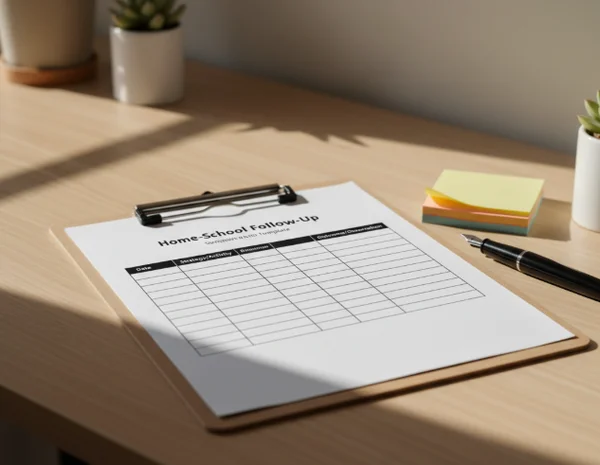
Documentation template for home-school follow-up over 4 to 6 weeks
A short follow-up period can improve decision quality after initial screening. A practical window is 4 to 6 weeks of structured observation when immediate risk is not present.
Use a shared template with four fields:
- Setting and time block (home morning, class transition, homework hour)
- Target behavior observed
- Support strategy used
- Outcome after strategy
Keep entries brief and concrete. One or two lines per event are enough. Long narrative notes can hide patterns that shorter structured logs reveal.
At weekly checkpoints, compare what improved, what worsened, and what stayed unchanged. This helps clinicians separate situational stress from persistent symptom patterns.
When preparing for the next appointment, combine form scores and observation logs in the screening report dashboard. A combined packet usually supports clearer and more efficient professional discussion.
Key takeaways and when to seek immediate professional help
Parent-teacher score differences are common and meaningful. They often reflect context, demand differences, and observation windows rather than one person being incorrect. The safest path is structured comparison, shared documentation, and professional follow-up.
Use Vanderbilt results as a screening input, then expand with concrete examples from home and school. This approach supports better conversations with pediatric and mental health professionals.
Seek immediate professional help when there are urgent safety concerns, severe emotional distress, or risk of harm. NIMH advises calling 911 or going to the nearest emergency room in life-threatening situations (NIMH Find Help). For crisis support, SAMHSA identifies 988 as a national hotline resource (SAMHSA 988).
If symptoms are severe or if symptoms persist, seek professional help from qualified clinicians rather than relying on screening results alone. Care decisions should be made through full clinical evaluation, not from a single tool output.
For non-urgent cases, keep communication active between home and school while waiting for appointments. Consistent updates often help clinicians see patterns faster and choose better next-step evaluations.