ADHD Chart Guide for Medication, Symptoms, and Support
An ADHD chart can be helpful when a family is trying to make sense of symptoms, treatment options, school notes, and daily routines. It can also become confusing fast, especially when search results mix ADHD medication chart PDF files, dosage tables, behavior charts, and symptom checklists on the same page. The safest way to use any chart is as an organizing aid, not a decision-maker. Parents and educators can use child ADHD screening observations to gather clearer information before a conversation with a pediatrician, psychiatrist, psychologist, or school support team.

What an ADHD Chart Can and Cannot Tell You
The phrase "ADHD chart" can mean several different tools. Some charts compare inattentive and hyperactive-impulsive signs. Others list ADHD meds by category, duration, or formulation. Some are home supports, such as routine charts, cleaning charts, chore charts, and reward charts. Others are clinical screening forms that help adults record how often certain behaviors appear across settings.
That variety matters because each chart has a different job. A medication chart is usually a discussion aid for a licensed prescriber. A symptom chart is a learning aid. A behavior chart is a home or classroom support. A screening scale is a structured way to collect observations. None of these should be used alone to label a child, choose a medicine, change a dose, or explain every behavior.
For families, the most useful chart is often the one that answers a practical question: What are we seeing, where is it happening, how often does it happen, and what support has already helped? When the chart brings those details together, it can make the next professional conversation more specific and less rushed.
Types of ADHD Charts People Search For
Many searches around ADHD charts fall into five broad groups.
| Chart type | Common search intent | Safer use |
|---|---|---|
| Symptom chart | Compare inattention, hyperactivity, impulsivity, and executive function signs | Learn vocabulary and notice patterns |
| Medication chart | Review stimulant and nonstimulant categories, release types, and duration | Prepare questions for a prescriber |
| Dosage chart | Look for age or weight-based dose examples | Avoid self-adjusting; ask the clinician |
| Conversion chart | Compare one medicine or formulation with another | Treat as clinician-only guidance |
| Routine or behavior chart | Build home, school, cleaning, or reward systems | Support daily structure and communication |
This is why a single "ADHD chart test" or "ADHD meds chart" is rarely enough. A family might need one chart to record symptoms, another to track sleep and appetite, and another to coordinate home and school strategies. The chart should reduce noise, not create a false sense that a complex clinical and educational picture can be solved by one table.
How to Read an ADHD Medication Chart PDF
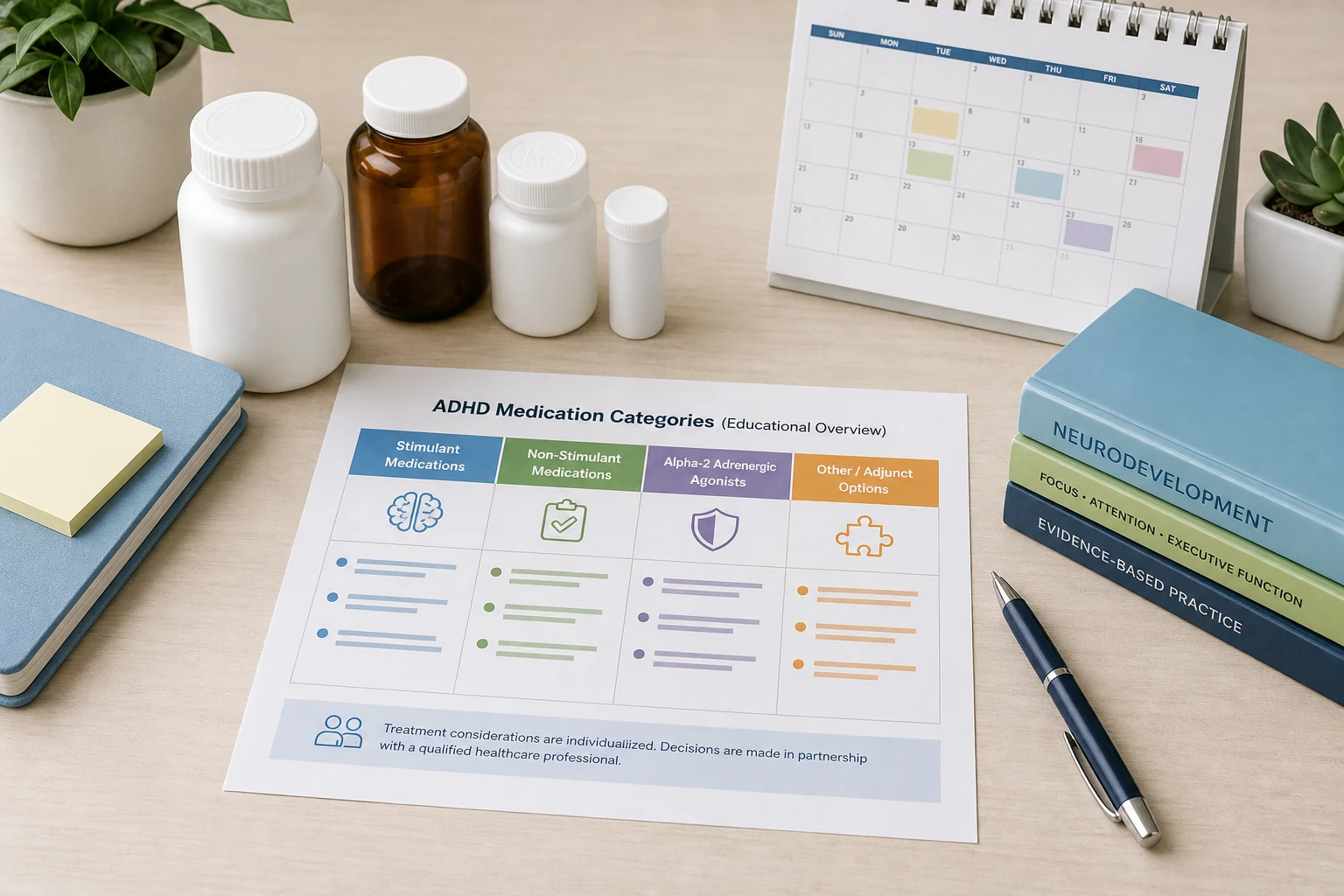
An ADHD medication chart PDF often groups medications into stimulants and nonstimulants. Stimulants are commonly divided into methylphenidate-based and amphetamine-based medicines. Nonstimulant options may include medicines that work through different pathways and may take longer to show full effects. Many charts also show whether a product is immediate-release or extended-release, plus typical duration ranges.
That information can be useful, but it has limits. Medication response varies by child, age, health history, other medicines, sleep, appetite, school schedule, and side effects. Two children can take the same medicine and have very different experiences. A chart may help you ask better questions, but it should not be used to select a product without medical guidance.
When reviewing an ADHD medication chart 2024 or newer, check whether the source explains its review date, whether it separates children from adults, and whether it warns against changing medication without a prescriber. If the chart includes exact doses, treat that part as professional reference material. For a parent, the safer focus is category, duration, possible side effects to monitor, and what questions to bring to the appointment.
Why ADHD Medication Dosage Charts for Kids Need Caution
Searches for an ADHD medication dosage chart for kids are understandable. Parents want to know what is normal, what is too much, and whether a child's experience is expected. The problem is that pediatric dosing is not just a number on a chart. Clinicians consider age, weight, symptom pattern, medical history, side effects, timing, school demands, and whether the child has anxiety, tics, sleep problems, appetite concerns, or other needs.
Instead of using a dosage chart to make a change, use it to prepare a safer conversation. Bring notes about when the medicine starts helping, when it seems to wear off, what happens at lunch, how sleep has changed, whether mood shifts appear late in the day, and what teachers observe. These details are more useful than guessing from a table.
If a child has new chest pain, severe mood changes, fainting, hallucinations, suicidal thoughts, or any urgent symptom, seek immediate medical help. For less urgent concerns, contact the prescriber before changing timing, dose, or formulation.
ADHD Med Conversion and Equivalency Charts
An ADHD med conversion chart can look precise, but conversion is one of the least parent-friendly chart types. Different stimulant classes do not convert cleanly. Immediate-release and extended-release products can deliver medicine differently across the day. Even medicines with similar active ingredients can feel different because of formulation, release curve, and individual metabolism.
That is why conversion charts belong in clinician-led decision-making. A parent can still use the chart in a productive way by asking, "If we switch, what are we trying to improve?" and "What should we watch during the first week?" Good switch conversations often focus on coverage during school hours, appetite, sleep, rebound irritability, homework time, and whether the child seems more like themselves or less like themselves.
If you are using a Vanderbilt-style observation record, medication conversations can become clearer because home and school observations are separated. A teacher may see better task completion while a parent sees evening rebound. Both can be true, and both should be part of the discussion.
Symptom, Behavior, and Routine Charts for Home and School
Not every useful ADHD chart is about medicine. For many children, practical charts are part of daily support. A morning routine flow chart can reduce repeated verbal reminders. A chore chart can break a large task into visible steps. A reward chart can make expectations concrete. A behavior chart can help adults notice triggers, transitions, and patterns across the week.
These supports work best when they are simple. A chart with ten goals can overwhelm a child who already struggles with working memory and task initiation. Start with one routine, one setting, or one behavior. Use short labels, predictable timing, and visible completion cues. Review the chart calmly, and adjust it if the child is repeatedly stuck at the same step.
For school, charts should support communication rather than blame. A teacher might track independent work starts, assignment completion, transitions, or peer interruptions. A parent might track sleep, breakfast, homework, screen transitions, and evening mood. When shared respectfully, the two views can help the support team see whether a pattern is global, setting-specific, or tied to a certain part of the day.

A Safer Checklist for Comparing ADHD Charts
Before you rely on any chart of ADHD medications, symptoms, or routines, run it through this checklist:
- Does it say who the chart is for: children, teens, adults, parents, teachers, or clinicians?
- Does it separate education from treatment decisions?
- Does it avoid promising certainty from a simple score or table?
- Does it explain when to involve a qualified professional?
- Does it help you record real observations across time?
- Does it leave room for context, such as sleep, stress, school demands, and co-occurring concerns?
- Does it make your next step clearer without pressuring you?
A high-quality chart should make you better prepared, not more alarmed. It should also fit the question you are asking. If you are trying to understand classroom behavior, a medication list will not help much. If you are preparing for a prescriber visit, a chore chart will not answer medication safety questions. Matching the chart to the task is the first step toward using it well.
Turning an ADHD Chart Into Next-Step Notes
The best ADHD chart is the one that helps adults describe what is happening in plain language. After you review a symptom, medication, dosage, or routine chart, turn it into notes you can actually use:
- What are the top two concerns right now?
- Where do they happen most: home, school, activities, or multiple settings?
- What time of day is hardest?
- What has helped, even a little?
- What has made things worse?
- What questions should be asked before any treatment change?
For children ages 6-12, a structured screening tool can help parents and teachers organize behavior observations before a clinical or school meeting. Vanderbilt Assessment resources are designed for that early organizing step, while medical treatment decisions remain with qualified professionals. If you want a clearer way to collect parent and teacher observations, you can explore structured ADHD screening support and use the results as one piece of a broader conversation.
FAQ
What is the best ADHD chart to start with?
Start with the chart that matches your question. If you are trying to understand patterns, use a symptom or observation chart. If you are preparing for a medication visit, use a medication category chart only to prepare questions. If daily life is the main challenge, start with a routine or behavior chart.
Is an ADHD medication chart PDF enough to choose medicine?
No. A medication chart can explain categories, duration, and common terms, but medicine choice should be guided by a licensed prescriber who knows the child's health history, symptoms, side effects, and goals.
Should parents use an ADHD medication dosage chart for kids?
Parents can use one to understand vocabulary, but not to change a child's medicine. Pediatric dosing depends on individual factors, and changes should be discussed with the prescriber.
What does an Adderall crash feel like?
Some people describe a late-day wear-off period with irritability, tiredness, low mood, hunger, or return of ADHD symptoms. If this pattern appears, record timing and symptoms, then discuss it with the prescriber.
Does Adderall age you?
There is no simple aging chart for Adderall. Concerns usually relate to sleep, appetite, blood pressure, heart rate, mood, and misuse risk. A clinician can help weigh benefits, side effects, and monitoring needs.
What happens if you take Adderall and do not need it?
Taking a prescription stimulant without medical supervision can be risky and may cause side effects, misuse, dependence, or serious harm. Do not share or use someone else's medication.
What is the best medication for ADHD?
There is no single best medication for every person. Clinicians consider symptom pattern, age, health history, side effects, duration needs, and family priorities. Behavioral and school supports may also be part of care.