Vanderbilt Assessment vs. Conners: Choosing Your ADHD Screening Tool
Feeling overwhelmed by your child's behavioral concerns is completely normal for parents and educators. When you notice a child struggling with focus or hyperactivity, finding trustworthy information is often the crucial first step. This search quickly leads to two prominent names: the Vanderbilt and the Conners scales. But in the Vanderbilt vs. Conners debate, how do you know which is the right starting point? What is the best ADHD assessment tool for your specific needs?
This guide provides a clear, professional comparison of these two leading rating scales. As an expert in evaluating online tools, I'll break down their purposes, structures, and key differences. Our goal is to empower you with the knowledge to make an informed decision and take the most effective next step in understanding a child's behavior. If you're looking for a clear, authoritative, and accessible starting point, an online vanderbilt assessment can provide immediate insights.

Understanding the Vanderbilt ADHD Assessment Scale
The Vanderbilt ADHD Assessment Scale is a highly respected and widely used tool for the initial screening of Attention-Deficit/Hyperactivity Disorder (ADHD) in children aged 6 to 12. Its development was supported by the National Institute for Children's Health Quality (NICHQ) and it is recommended by the American Academy of Pediatrics (AAP). This endorsement highlights its authority and reliability in primary care and school settings.
Purpose and Structure of the Vanderbilt Assessment
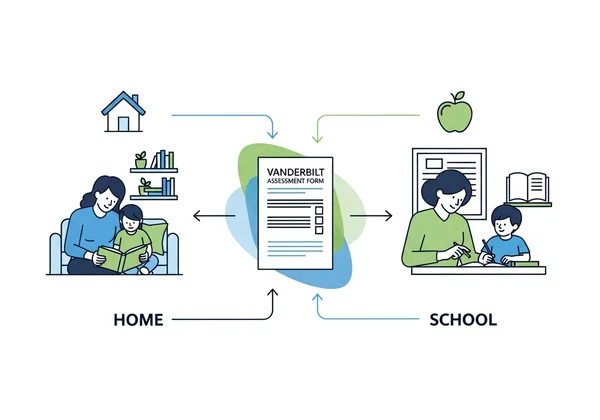
The core purpose of the Vanderbilt is to provide a standardized method for parents and teachers to report on a child's behavior. This ensures that observations from different environments (home and school) can be collected and compared consistently. The tool consists of two main versions:
- Vanderbilt Assessment Parent Form: Completed by a parent or guardian, this form asks about the child's behaviors observed at home and in social settings.
- Vanderbilt Assessment Teacher Form: Completed by a teacher, this form gathers insights into the child's conduct in the academic environment, such as classroom attentiveness and peer interactions.
Each form contains a series of questions related to specific symptoms, which are rated based on their frequency. The structure is designed to be straightforward, making it easy for non-clinicians to complete accurately.
What the Vanderbilt Screens For (Beyond Core ADHD Symptoms)
A key strength of the NICHQ Vanderbilt assessment scale is its comprehensive scope. While it thoroughly screens for the primary symptoms of ADHD (inattention and hyperactivity/impulsivity), it goes further. The scale also includes questions to identify signs of other common co-occurring conditions that often appear alongside ADHD.
This includes screening for:
- Oppositional-Defiant Disorder (ODD)
- Conduct Disorder (CD)
- Anxiety
- Depression
This broader view is invaluable for an initial screening, as it can help flag multiple areas of concern that may require further professional evaluation. It ensures that related challenges aren't overlooked during the preliminary assessment phase.
Introducing the Conners Rating Scales
The Conners Rating Scales are another cornerstone in the world of behavioral assessment. Developed by Dr. C. Keith Conners, these scales have a long history and have evolved over decades, with the most recent version being the Conners 3rd Edition (Conners 3®). They are considered a robust tool for assessing ADHD and its most common co-occurring problems.
Overview of Conners Scales: Versions and Evolution
Unlike the Vanderbilt, the Conners suite of tools is more extensive and includes various forms tailored to different age groups (from preschoolers to adults) and informants (parents, teachers, and self-report). The Conners 3, for example, offers long and short forms, allowing clinicians to choose the level of detail required for an evaluation. These scales are proprietary, meaning they must be purchased, scored, and interpreted by trained professionals.
Primary Areas Measured by Conners Scales
The Conners scales provide a detailed look at a wide range of behavioral, emotional, and academic issues. The primary areas measured are similar to the Vanderbilt but are often more granular. The scales typically assess for:
- Inattention and Hyperactivity/Impulsivity
- Learning Problems
- Executive Functioning
- Aggression and Defiance
- Peer and Family Relations
Because of their depth and the requirement for professional administration, the Conners scales are often used in clinical, psychological, or psychiatric settings for a more detailed diagnostic workup, rather than as an initial screening tool in primary care.

Vanderbilt vs. Conners: A Detailed Comparison
When choosing between these two powerful rating scales for ADHD, it's crucial to understand their fundamental differences. Both are valuable, but they are designed for slightly different purposes and audiences.
Key Differences in Design, Scoring, and Administration
- Accessibility: The Vanderbilt Assessment Scale is publicly available and often free to use. This makes it an incredibly accessible first step for concerned parents and educators. Platforms like this one offer a free vanderbilt assessment online with instant, automated scoring, removing barriers to getting started. The Conners scales, in contrast, are commercial products that must be purchased and administered by a licensed professional.
- Purpose: The Vanderbilt is primarily designed as a screening tool. It excels at identifying children who are at risk and need a more formal evaluation. The Conners is often used as part of that formal diagnostic evaluation, providing a deeper, more nuanced look at a child’s symptoms.
- Scoring: While both have standardized scoring protocols, the Vanderbilt's scoring is more straightforward and can be automated easily. This allows for the immediate generation of a report, which is a key feature of our online ADHD tool. Conners scoring is more complex and typically requires specialized software or manual scoring by a trained clinician.
Strengths and Limitations of Each Assessment Tool
Vanderbilt Assessment Scale:
- Strengths: Highly accessible (free), recommended by the AAP, comprehensive screening for common co-occurring conditions, and easy to administer and score. It is the perfect initial ADHD screening tool.
- Limitations: It is not a diagnostic tool. A high score indicates a need for follow-up but does not confirm a diagnosis.
Conners Rating Scales:
- Strengths: Highly detailed and specific, multiple versions for different needs, strong psychometric properties for clinical use, and can contribute significantly to a formal diagnosis.
- Limitations: Costly, requires a trained professional for administration and interpretation, and is less practical for quick, initial screenings in a school or primary care setting.
Which ADHD Screening Tool is Right for Your Child?
Ultimately, the choice depends on where you are in your journey of understanding a child's behavior.
When to Prioritize the Vanderbilt Assessment
You should prioritize the Vanderbilt Assessment if:
- You are a parent or teacher with initial concerns about ADHD or related behaviors.
- You want a quick, reliable, and cost-free way to gather preliminary information.
- You need a standardized tool to facilitate a productive conversation with a doctor or school counselor.
- You want to screen for not just ADHD, but also common co-occurring conditions like anxiety or ODD.
The Vanderbilt is the ideal first step. It provides a structured overview of potential issues without the cost and complexity of a full clinical evaluation. Taking a vanderbilt assessment online test is a convenient and confidential way to gather the initial data you need.
When the Conners Scale Might Be More Appropriate
The Conners Scale is more appropriate when:
- A child has already been identified as high-risk through an initial screening (like the Vanderbilt).
- A psychologist, psychiatrist, or pediatrician is conducting a comprehensive diagnostic evaluation.
- A more detailed analysis of specific symptoms or behaviors is required to inform a treatment plan.
The Conners is typically the "next step" after a positive screening, not the starting point.
The Crucial Role of Professional Consultation in Diagnosis
It is absolutely critical to remember that neither the Vanderbilt nor the Conners scale provides a diagnosis. They are data-gathering tools. The ADHD diagnosis process is a comprehensive medical evaluation conducted by a qualified healthcare professional, such as a pediatrician, child psychiatrist, or psychologist. This evaluation includes a clinical interview, a review of developmental history, and often the results from rating scales like these. The reports from these tools are valuable pieces of the puzzle, but a professional must put the whole picture together. For more information on ADHD, you can visit resources like CHADD.

Next Steps: Empowering Your Child's Journey
When considering your child's needs, remember that choosing between the Vanderbilt and Conners scales isn't about finding a 'better' option, but the right one for your family's current situation. For most parents, teachers, and primary care providers seeking initial insights, the Vanderbilt Assessment Scale offers a practical, authoritative, and accessible first step. It provides a clear snapshot of a child's behavior, giving you valuable information to begin a meaningful conversation with a healthcare professional.
If you are ready to gain clear, immediate insights into your child's behavior, the journey starts here. Our platform offers the official NICHQ Vanderbilt Assessment with instant, automated scoring. You can even opt for an exclusive AI-powered report that provides deeper, personalized insights and actionable guidance.
Take the first step today to better understand and support your child.
Frequently Asked Questions About ADHD Screening Scales
What conditions does the Vanderbilt Assessment screen for?
The Vanderbilt Assessment is designed to screen for the primary symptoms of ADHD (both inattentive and hyperactive/impulsive types). Critically, it also includes components to screen for common co-occurring conditions such as Oppositional-Defiant Disorder (ODD), Conduct Disorder (CD), anxiety, and depression.
Is the Vanderbilt ADHD assessment accurate for preliminary screening?
Yes. The Vanderbilt Assessment is considered a reliable and valid tool for preliminary screening. It is endorsed by the American Academy of Pediatrics for this purpose. However, its accuracy is for identifying children who need further evaluation, not for making a final diagnosis.
Can the Vanderbilt Assessment be used for adults with ADHD symptoms?
The standard NICHQ Vanderbilt Assessment Scale was specifically designed and validated for children aged 6 to 12. It is not intended for use with adults. Adults with ADHD symptoms should consult a healthcare provider who can use assessment tools designed for adult populations.
How do these scales differ in terms of parent and teacher input?
Both the Vanderbilt and Conners scales value input from parents and teachers and have separate forms for each. The primary difference is in accessibility and purpose. The vanderbilt parent form and teacher forms are freely available and ideal for initial screening. Conners forms are part of a larger, proprietary toolkit used in formal clinical evaluations.
What does a high score on the Vanderbilt or Conners assessment mean?
A high score on either assessment indicates that the child is showing a significant number of symptoms related to ADHD or other behavioral/emotional disorders. It does not mean the child has a diagnosis. It is a strong signal that you should schedule an appointment with a pediatrician or mental health professional to discuss the results and determine the next steps for a full evaluation. You can discover your results instantly on our platform to facilitate that conversation.